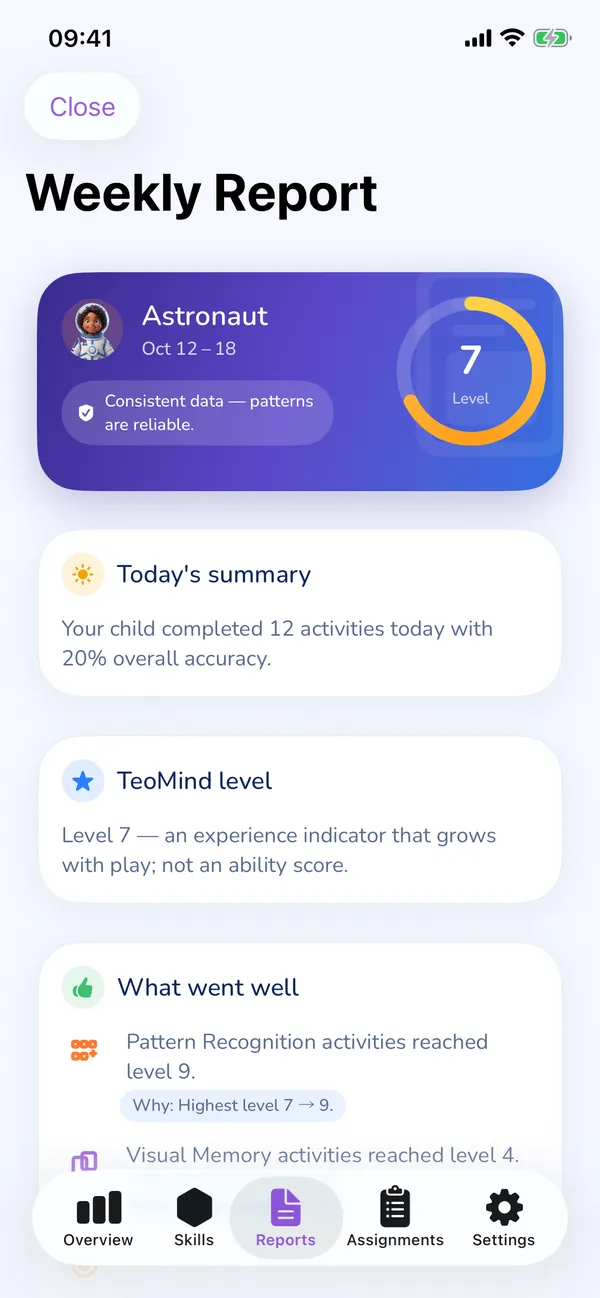
A level for every skillEach of the 14 skills has its own level from 1 to 10. The age group caps the highest level a child can reach.
Difficulty has many dimensionsDifficulty is not a single speed setting: visual complexity, memory load, processing speed, distractors, instruction length, rule complexity and spatial complexity are tuned separately. A visual search never raises memory load; a memory game never raises speed.
Every round is assessedAccuracy, false responses, missed targets and reaction time are compared with what the level expects, and the round is marked fluent, steady, struggling or a sharp drop.
Going up needs evidenceA level rises by one when two of the last three rounds were fluent and none was a struggle. One lucky round is not enough.
So does going downTwo struggles in a row, or one sharp drop, lower the level by one. A single mistake never knocks a child back.
Uneven results mean waitingIf results go up and down, the level holds. A change is never bigger than one step, and after every change fresh rounds are needed.
Hints are not masteryA question solved with a hint counts as a success, but not as evidence for moving up.
Every challenge is validatedEach of the 2,423 challenge configurations in the catalogue is checked automatically — structure, logic (exactly one right answer), playability, level, age, layout and repetition — before a child ever sees it.